Wildfire vulnerable communities live within a continuum that is cyclical, often navigating between pre-wildfire mitigation and post-fire restoration, with the occasional (we hope!) wildfire response. This reality requires frequent community action and active land management. 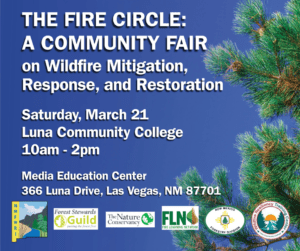
Pre-fire mitigation is a way of life and might include: cleaning up gutters annually; limbing trees and shrubs that are close to homes, sheds, power lines and other infrastructure; raking up leaves that collect in the corners of porches and courtyards; carefully disposing of hot coals from woodstoves; thinning green forests to reduce tree densities and ladder fuels; and burning piles of slash when conditions are good.
Recovery following large fires, like the Hermit’s Peak / Calf Canyon (HPCC) fire, will take years and perhaps even decades, with flooding continually resetting the clock for progress made. Post-fire restoration is a long-term commitment that might begin with stabilizing soils, diverting debris away from critical infrastructure such as acequias, stock ponds, and fences, and protecting water resources, especially drinking water. Muddy water that moves across the landscape after a fire can be used to plug and refill arroyos and gullies through erosion control structures. Reseeding can improve dozer lines or other degraded sites impacted by heavy equipment during the wildfire response and rehabilitation. These issues and more are still impacting the daily lives of communities impacted by HPCC, even as we approach the 4th anniversary of New Mexico’s largest recorded fire.
The Fire Circle is a community convening for co-learning, knowledge exchange and resource gathering. At the fair, community members can gain updates on:
- Groundwater contaminants in our drinking water;
- Hazard tree removal to protect the Mora/San Miguel Coop electric lines;
- New Mexico’s new Wildfire Prepared Homes initiative and how it can; impact your homeowners insurance
- What is growing back in our forests after the HPCC fire;
- Why volunteer firefighters are your first line of defense in a wildfire.
The fair will also bring together many organizations who are offering resources for landowners and homeowners, live demonstrations, and activities. Many communities remain vulnerable to wildfires as we have many acres of green islands within, and forests adjacent to, the HPCC burn scar. The Fire Circle
Fair attendees can:
- grow their knowledge
- ask questions
- talk to restoration professionals
- bring in unknown plants for identification
- learn the status of public trails access for your upcoming hunt
- and pick up a ton of free resources, including a free lunch!
We hope to see you there!
