By Vincent Vispo, NMFWRI Seasonal Monitoring Technician
Of the projects the monitoring crew completed for the 2025 GRGWA season, a favorite were the 12 projects in Rancho De Taos thanks to the beautiful landscapes and furry friends that joined them on plot. Friendly horses, dogs, and hungry cows provided company to the crew as they counted stems, identified plants, and quantified tree canopy cover. Besides
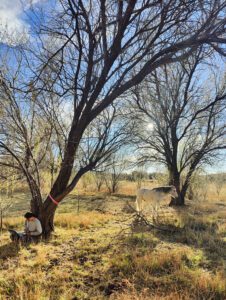
mountain landscapes and animal friends, the ever-pervasive Russian Olive was always nearby and inspired the following reflection from ecological monitoring technician Vincent Vispo.
I’m just going to come right out and say it: Russian olive (Elaeagnus angustifolia, or ELAN on our datasheets) is a beautiful tree. A couple weeks ago when we were in Taos conducting pre-treatment monitoring we spent many hours beneath the swaying silver canopies of this invasive, and when the sun was setting and the full moon rising the light filtering through its leaves was ethereal. It made me sad, frankly, knowing that I was part of the first step towards removing these trees and that the next time a monitoring crew comes through they will not be able to enjoy their gentle shade. The contractors who come in after we have recorded pre-treatment data are nothing if not thorough: comparing photos from before and after removal on other projects attests to their tenacity. (See before/after slides below of a project in Belen).
My week in Taos gave me other doubts, not all of which were of a personal aesthetic nature. Invasives like Russian olive provide food and cover for many species – is this unique habitat or could other, native, species provide the same environment? What species is that habitat most beneficial for? If the invasives are removed, what takes their place? Are they really occupying a niche that would still otherwise be filled, or have the native species that once anchored the soil in these areas been pushed out by other stressors? Many of the plots that we monitor are highly disturbed, and perhaps invasives are the only species willing to tolerate such harsh conditions.
Of course, I am familiar with the arguments for why Russian olive should be removed. I am not the first person to think E. angustifolia is beautiful: it was introduced to the United States in the early 1900s for ornamental plantings (Christensen, 1963) and since then, this hardy tree has spread throughout all western and mid-western states, where it tends to occur along rivers (Katz, 2016). Efforts to restore riparian habitat, like those organized by the Greater Rio Grande Watershed Alliance for which NMFWRI provides monitoring, include the removal of such invasive species with the goal of reducing fire risk, supporting native vegetation, and generally returning the bosque to a “natural” and functional ecosystem (NMFWRI, 2024).
However, the evidence (and research) on the (dis)functionality of Russian olive-dominated ecosystems is limited. Katz (2016) provides an overview of some the effects that we are aware of.
Russian olive fixes nitrogen with the help of actinomycetes (bacteria with a thick layer of peptidoglycan within their cell wall) in the genus Frankia (Miller & Baker, 1985), meaning its foliage has a high N content as compared to native cottonwoods (literature review in Katz, 2016). This may alter soil microbial communities. It is able to tolerate both shade and – of particular interest given our changing climate – low moisture conditions better than cottonwood (Reynolds & Cooper, 2010). Combined with its high salt-tolerance (Monk & Wiebe, 1961), this suggests that it might be able to fill niches not occupied by native species – particularly in more extreme environments.
Although there is limited research on the subject, Russian olive may also impact riparian water availability, especially since it is able to establish itself under mature cottonwoods. Such a stand, with a developed cottonwood canopy and an extensive understory of salt cedar and E. angustifolia was found to have the highest rates of evapotranspiration in the Rio Grande bosque (Dahm et al., 2002).
Unsurprisingly, there is more exotic vegetation cover under Russian olive, and its establishment alters woody plant communities with knock-on effects for secondary consumers. While E. angustifolia stands support high densities of avian visitors, these communities are slightly less diverse than those in structurally similar native-only equivalents (Knopf & Olson, 1984). Of course, how establishment changes bird communities depends on what was growing in the area before. When Russian olive moves in under a cottonwood overstory it may provide new nesting habitat without excluding species such as cavity nesters, but where it creates a shrub or forest habitat in what was grassland or wet-meadow it necessarily favors a community adapted to the woody environment. Whether that is a good or bad thing depends on our perspective and how we value these species compositions.
Considering these nuances, Katz, following Sogge et al. (2013), recommends three guidelines for Russian olive control: recognizing that removal will benefit some species but harm others; balancing removal with native habitat restoration; and managing some areas for a mixed native-exotic habitat. Katz also emphasizes that invasive species removal alone does not necessarily constitute “restoration.” Often follow-up removals or native plantings are required to reach desired results.
Carefully considering what these desired results are is incredibly important. We may like to say that we are simply “restoring” nature and leave it at that, but we should look deeper. Why are we restoring nature, and to what? When we asked our contact at the Taos Soil and Water Conservation District for his elevator pitch on the restoration projects he had helped organize, he mentioned several reasons: watershed health; native species habitat; and, crucially, grazing land reclamation. When we humans apply our efforts to change a landscape it is because (needless to say) we see more value in its changed state and think that the effort expended is worth moving it to that state. The value we seek to increase may be directly measurable, e.g. increased beef output, or more intangible – like nebulous feelings of contentment about the knowledge that native species now have more habitat.
I may question whether removing Russian olive really makes these ecosystems more “valuable,” but to someone else it might be crystal-clear since we all assign importance to these factors differently. That is a-okay, as long as the reasons for treatment are fully considered. It is all too easy to fall into heuristics like “invasives = bad,” which can cause the inefficient allocation of resources since they lead to decisions that do not actually reflect the considered values of the decision makers, only their emotional learned responses.
This is also why our monitoring work is so important. Every management decision is made because we are attempting to bring land closer towards a desired state. Once that state is established it then becomes critical to follow and record the change. At its most basic this may be to ensure that contracts are fulfilled, but the data we collect is also vital for informing further decisions. If we have doubts about what restoration really achieves or whether it leads to a more “valuable” ecosystem, what better way to answer those doubts than seeing for ourselves?