Collaboration staff present on SWCD role in effective wildfire mitigation
By Alejandro Collins, Collaboration Specialist
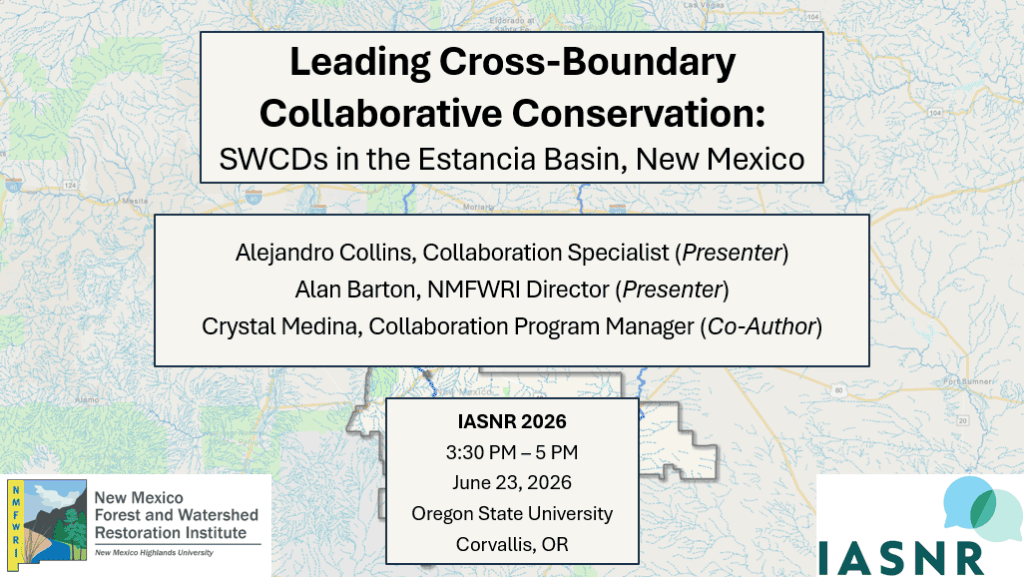
In June, Collaboration Specialist Alejandro Collins attended the 40th annual conference of the International Association for Society and Natural Resources in Corvallis, Oregon. Alejandro partnered with NMFWRI Director, Dr. Alan Barton, to give a presentation titled “Leading Cross-Boundary Collaborative Conservation: SWCDs in the Estancia Basin, New Mexico”. Their presentation explored how and why four Soil & Water Conservation Districts (SWCDs) in the Estancia Basin have been models of collaborative conservation for the rest of New Mexico. Dr. Barton and Alejandro combined a case study from 2018 with more recent work by the NMFWRI Collaboration Program and the Claunch-Pinto SWCD to demonstrate how SWCDs can be well- positioned to lead wildfire mitigation efforts.
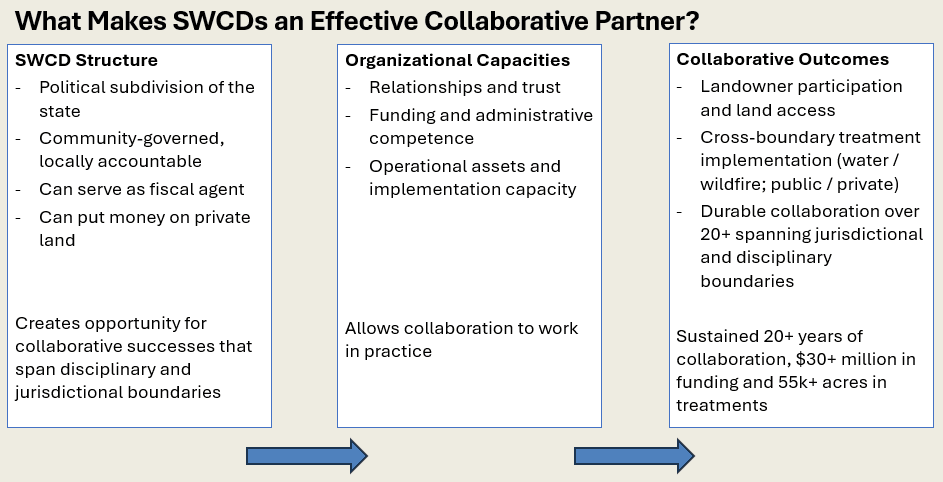
The work conducted by SWCDs in the Estancia Basin is particularly unique due to its success in bringing together diverse SWCDs and disciplinary expertise, spanning geographic and ecological boundaries. The effort, across public, private, and common property regimes, secured more than $30 million for landscape-scale wildfire mitigation treatments across 55,000 acres, much of it on private property.
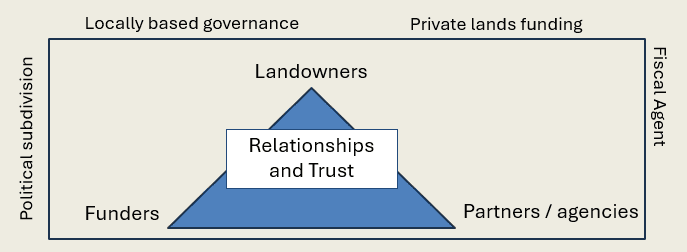
A graphic demonstrating the elements important to successful collaborative conservation efforts.
SWCDs, as political subdivisions of the state, are afforded structural flexibility and locally based governance that create opportunities for cross-boundary collaboration. However, structure alone is not enough. Dr. Barton and Alejandro highlighted how long-term leadership and collaborative partnerships at the Claunch-Pinto SWCD fostered trust-based relationships and operational capability, enabling partners to work effectively across disciplinary, property, and geographic boundaries. The presentation concluded that, under the right conditions, SWCDs are well-positioned to coordinate, implement, and sustain landscape-scale wildfire mitigation.