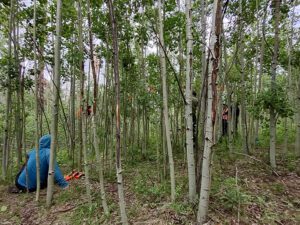
The Ecological Monitoring crew takes down data on trees and shrubs within the Hermit’s Peak/Calf Canyon burn scar on Johnson Mesa in 2025. Photo by Taryn Schlosser / NMFWRIThis is the number of stems (across 28 species of trees and shrubs) recorded by the NMFWRI monitoring crew on our upland monitoring plots across the Hermit’s Peak/Calf Canyon burn scar this summer. This number, dominated by species such as Kinnickinnick, Mountain-lover, Fendler’s buckbrush, and Wood’s rose among others, reflects the regeneration occurring particularly in mixed-conifer shrubs.
The Ecological Monitoring team also began their fall 2025 riparian monitoring workNMFWRI’s Ecological Monitoring program worked in October with the Greater Rio Grande Watershed Alliance with 10-year revisits to invasive species removal projects in the Grants area. Photo by Vincent Vispo / NMFWRIwith the Greater Rio Grande Watershed Alliance with 10-year revisits to invasive species removal projects in the Grants area. The Greater Rio Grande Watershed Alliance (GRGWA) is a collaboration of soil and water conservation districts (SWCDs), Pueblos, agencies, and stakeholders along the Middle Rio Grande Watershed working on landscape-scale watershed restoration, with a focus on non-native phreatophyte removal from the bosque (learn more here: https://nmfwri.org/monitoring/greater-rio-grande-watershed-alliance/.)
In October, the monitoring team also conducted grazing utilization surveys in 15 key areas on the Santa Fe National Forest, participated in the biannual Cross-SWERI Monitoring and Research Workshop with our partners from the Ecological Restoration Institute (ERI) and the Colorado Forest Restoration Institute (CFRI), supported two of our student interns in presenting their work (burned tree and riparian plant identification guides) at the Alliance for Minority Participation Student Research Conference in Las Cruces, and sent five program staff to the Black Lake prescribed burn.