By Emily Yannayon,
NMFWRI Ecological Monitoring Specialist
Some plants have no chlorophyll – the pigment essential for photosynthesis. They are achlorophyllous.
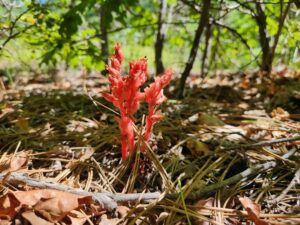
Without this pigment, how do these plants procure energy and nutrients? Many achlorophyllous plants are parasites of the mycorrhizal fungi associated with trees. This is known as mycoheterotrophy – the “fungus eaters.” The presence of mycoheterotrophs in a forest indicates a robust and relatively undisturbed soil ecosystem. It takes time for fungal networks to develop. The mycelium must seek out and establish partnerships by forming connections with tree roots. The fungi must also have time to decompose the litter produced by their arboreal partners, in order to produce energy, but also to recycle nutrients back into the trees. Highly disturbed forests, such as clearcuts, lack this vital fungal organ.
Only once there is a healthy fungal support network, can mycoheterotrophs establish themselves. Mycoheterotroph may be a misnomer, however. This topic is difficult to study, but some findings have suggested that these plants are not true parasites. The definition of a parasite is an organism that takes advantage of another, while providing nothing in return, often causing harm to its host. Research suggests mycoheterotrophs may provide a service for their host: they may be able to transform or free up certain types of nutrients that the fungi cannot, or they provide a physical structure that could house or assist the movement of mycelium through the soil.
This particular mycoheterotroph, Pinesap (Hypopitys monotropa), was documented as part of a pilot understory plant diversity study in NMFWRI ecological monitoring. This project sampled 12 plots during the 2025 growing season, in an attempt to capture botanical diversity across Ponderosa pine and dry mixed conifer forests following the Hermit’s Peak-Calf Canyon wildfire. These 12 plots were distributed across three conditions: burned in the HPCC wildfire and received thinning treatments, burned and untreated, and unburned and untreated. Pinesap was documented only in the unburned plots in Ponderosa pine forest. Despite the name, this plant can be associated with other trees, such as aspen or oak. Ecological monitoring hopes that this study will inform the effects of wildfire and forest management practices on the diversity of understory plant species, which are vital to overall ecosystem health and function. Capturing highly detailed ecological data such as this can highlight the small, quiet, frequently overlooked beings that are, despite their diminutive stature, an integral part of our forests.