By Berit Robnett,
AmeriCorps VISTA Collaboration Specialist
The past year at the New Mexico Forest and Watershed Restoration Institute (NMFWRI) as an AmeriCorps VISTA was full of learning, growth, trial, and error. As I began my term late August of 2025, I joined the Collaboration Program as a Collaboration Specialist alongside Program Manager, Crystal Medina, and fellow Collaboration Specialist, Alejandro Collins.
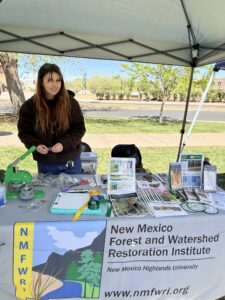
After I graduated from the University of New Mexico in May 2025, I was riddled with the anxiety of a freshly minted alum shifting into a now early career professional. I applied to the position with little to no experience; I had several years of customer service jobs previously, one advocacy internship, and now my shiny new Bachelor’s degree in Earth and Planetary Sciences. I’m beyond grateful for the chance NMFWRI took with me. Although I found this position by chance, it was something I knew I wanted to be a part of well before I could put a name to it.
Collaboration is around us at all times. Humans are programmed to live amongst one another, to connect through conversation and sharing food. I had been familiar with collaborating in everyday lived experiences, whether that be recording my classmates’ strike and dip measurements during field geology, cooking dinner with my roommate, or carpooling with my sister to our annual Mother’s Day picnic. I have been part of collaborating since I can remember.
Collaborative conservation was a whole new realm. Yes, I was familiar with how we can work with one another to create a shared mission, value, or idea. However, I had yet to apply what seemed like simple everyday skills to larger scale projects to benefit the safety, health, and future of New Mexicans and the land we call home. During my year of service, I learned the importance of collaborative conservation and how we can come together for our environment, using our own experiences, and complex intersectionalities to our advantage. Learning to grow with my community using a bottom-up approach was equally as important. Starting locally can mean the difference between certain voices being heard, the protection of our neighbors, and for ecosystems we grew up with to flourish.
Over the course of a year, it was amazing to see the range of experiences, culture, and personalities that work together for New Mexico. Prior to understanding collaborative conservation, I did not realize the importance of relationship building across landscapes. This was one of the hardest parts for me to understand when I first entered my role. After several 1:1 meetings with my manager, Crystal, I realized I was approaching it all wrong. Relationships take time and sometimes trust is built over decades. It can be a privilege to come together in person and work towards the protection of our forests, watersheds, and everything in between. This shift in perspective allowed me to be a service for people to come to rather than inserting myself in spaces I had not earned. You can only move as fast as your community will let you!
In collaborative conservation, we emphasize working together for environmental health and sustainable livelihoods. From my experience, communications across organizations, sharing resources, or meeting constraints can cause delay for tangible action to happen. Gathering perspectives and knowledge is one of the most important, and most valuable, parts of collaborative conservation. We must remember our work doesn’t end there. Continuing to show up to the table, leaving a seat empty for voices who have not been present in the past, and following words with actions will be the future of collaborative conservation.