Dr. Alan Barton, NMFWRI Director
Everywhere that people actively manage forests, reforestation plays a role. Reforestation is a way to restore lands following timber harvests, and a way to maintain a claim on open space against increasing suburbanization. In the 21st century, as large wildfires have become more prevalent, reforestation increasingly is a way to reestablish forests in burned areas. Natural reforestation can occur if there are enough seed bearing trees around a site; however, for all purposes, we can speed up regrowth of forests by growing and planting seedlings, rather than waiting for nature to reseed and regrow forests. This is especially important in areas affected by high intensity wildfires, as reestablishing forests across heavily charred landscapes is particularly challenging.
Recognizing the urgent need both for an ongoing supply of seedlings and for expertise in all aspects of reforestation, the New Mexico Forestry Division and three universities—New Mexico State University (NMSU), University of New Mexico (UNM) and Highlands University (NMHU)—have joined forces to create the New Mexico Reforestation Center (NMRC), with the goal of greatly increasing the number and quality of seedlings available each year, and ensuring that planting these follows a sound plan that maximizes the chances for success. For the past 7 years, representatives from these institutions have met and planned all aspects of this ambitious project, from fundraising to choosing a site to nursery design to creating an administrative structure.
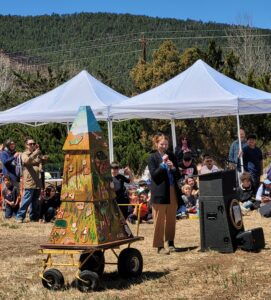
All of these efforts came to fruition in April, as a crowd of state dignitaries, university officials, natural resources professionals, local residents, and a contingent of students from local schools gathered in Mora, New Mexico, to witness a ceremonial groundbreaking to kick off construction of the NMRC. Several invited speakers shared their thoughts on this history-making project, including NMRC Director Dr. Jennifer Auchter and NMFWRI Deputy Director Dr. Edward Martinez, a Mora native. The event included the unveiling of the NMRC’s brand new logo, a display of artwork produced by schoolkids under the guidance of a local artist, lunch from local favorite Kenn’s Cuisine Hatcha’s, and lots of socializing among attendees.
Plans for the NMRC operations encompass the whole reforestation pipeline – scouting potential seed sources, seed collection and processing, growing seedlings in greenhouses, prepping sites, planting the seedlings, and following up to ensure the seedlings survive. Seed collection and processing is already underway at NMHU, and plans are to complete the first greenhouse in Mora in early 2027. The first crop of seedlings should be ready for planting in 2028. The NMRC will add additional greenhouses with the ultimate goal of producing five million seedlings per year. This sounds like a lot, but this is the number that is necessary to meet the demand in New Mexico and neighboring states.
As a partner in the NMRC, the NMFWRI congratulates Dr. Josh Sloan of NMHU, Dr. Owen Burney of NMSU, Dr. Matthew Hurteau of UNM, State Forester Laura McCarthy, and the rest of the executive board and staff members who have made this happen. The NMRC promises to be a valuable resource to New Mexico, and equally as important, a model for other wildfire-prone states to emulate. With the groundbreaking in the books, we look forward to the day—very soon—when the first trees will be transplanted and a burned site will be on its way to becoming a restored forest.