
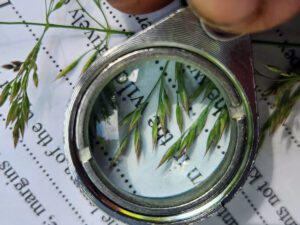
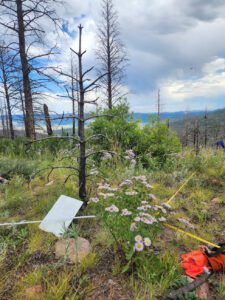
In 2025, the NMFWRI Ecological Monitoring Department piloted a study to quantify the diversity of understory plants within the HPCC burn scar. Monitoring transects were established within existing projects that received pre-fire mechanical thinning and prescribed burn treatments, and at sites that received no treatments before the fire. To serve as a control, NMFWRI also established plots in adjacent areas that were either unburned or experienced low-severity burning during the HPCC fire. The estimated cover of each species was collected at each plot, and data was analyzed based on certain traits: taxonomic family, growth habit, lifespan, and native or introduced status.
Monitoring staff identified 216 unique species in the study area, representing 156 genera across 52 families. The most abundant plant families were Asteraceae (daisies) and Poaceae (grasses), which is the norm across the western U.S. A single plot (1/10th of an acre) could contain nearly 60 species. Forbs (wildflowers) were the most species-rich growth habit, but the vegetation cover was dominated by trees, shrubs, and graminoids (grasses and grass-like plants).
The tree component in this study is restricted to seedlings and saplings in the understory – overstory, mature trees are not included. The tree component was dominated by species that are able to re-sprout from an underground rootstock following disturbance, such as a wildfire: specifically, Gambel oak (Quercus gambelii) and quaking aspen (Populus tremuloides). These trees are crucial for soil stabilization immediately following fire or other disturbances because they do not need to wait for ideal conditions for seed germination. Other tree and shrub species found in the study area can also re-sprout from underground rootstocks, but are not as vigorous as the Gambel oak and quaking aspen.
Twenty-five introduced plant species were documented across the study areas. Approximately half were annuals or biennials, half were long-lived perennials, and all were either forbs or graminoids. The majority of these species were likely present in the area prior to the HPCC fire, but are more prominent post-fire as they have taken advantage of the major disturbance event. Notable species include kochia (or “burning bush”), Canada thistle, musk thistle, tumbleweed, mullein, and cheatgrass. These plants are especially problematic because they can form dense monocultures, then quickly dry out in drought periods. This presents concerns for fire risk, because they can easily catch and carry flames. Despite the monocultures of introduced species observed in some areas, the vegetation cover of introduced species across the study plots were relatively low, at an average of 3.9% cover. The prominence of annual or biennial species also pales in comparison to that of long-lived (5+ years) perennials. This indicates that the study areas are no longer in an early successional stage.
Pre-fire treatment history appeared to have mixed effects within the study area. When an area was treated for fuels reductions prior to the HPCC fire, more overstory trees survived, on average. The intensity of pre-fire fuel treatments, as well as HPCC fire intensity, was highly variable, as were its effects. This resulted in a highly variable landscape with many different micro-habitats, that therefore supported highly variable plant communities. Some understory communities were dominated by bunchgrasses, oaks, shrubs, or forbs; depending on elevation, local climate, moisture, microsite variability, and the history of disturbance. Rather than focusing on reference conditions, which range widely, NMFWRI encourages prioritizing ecosystem resilience, as well as adaptations to increasing disturbance as well as conditions such as drought. The productivity and species diversity observed in this inventory is a trend towards resilience of these ecosystems.
See the the full-length report detailing these results here.

Why are understory plants important?
- They provide food and shelter for species of vertebrate and invertebrate animals, each of which contribute to food webs and ecological function. Some of these animals are important game species, such as turkeys and elk (1, 7).
- Gambel oak, one of the most dominant species in the understory inventory, can produce 500-625 pounds of acorns per acre in a year with adequate moisture (3).
- The plants stabilize soil, which mitigates flash flooding and reduces debris flows.
- They help water infiltrate, aiding in aquifer recharge. The slowing of water flow helps to improve water quality (1, 6).
- They host mycorrhizal fungi and beneficial microorganisms, which cycle nutrients and benefit overstory trees (1).
- The understory plants provide cooling and moisture retention at microsites. Shield tree seedlings from sun, wind, and herbivores – A.K.A. the “nurse shrub” effect (2, 4, 5, 8).
- Globally, understory vegetation accounts for more than 80% of species diversity (1).
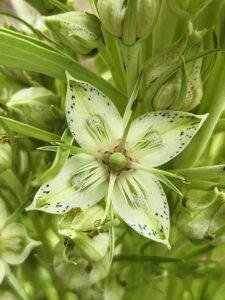
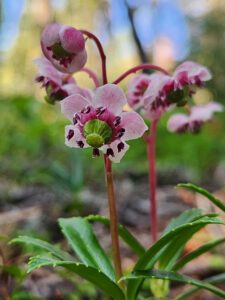
*All photos by Emily Yannayon/NMFWRI
References / Further Reading:
- Deng, J.; Fang, S.; Fang, X. et al. (2023). Forest understory vegetation study: current status and future trends. Forestry Research 3:6 DIOi: 10.48130/FR-2023-0006
- Graham, R. T. & Jain, T. B. (2005). Ponderosa Pine Ecosystems. Gen. Tech. Rep. PSW-GRT-198. Pacific Southwest Research Station, Forest Service, U.S. Department of Agriculture.
- Harper, K. T.; Wagstaff, F. J.; & Kunzler, L. M. (1985) Biology and management of the Gambel oak vegetative type: a literature Review. General Technical Report INT-179. Ogden, UT: U.S. Department of Agriculture, Forest Service, Intermountain Forest and Range Experiment Station.
- Laacke, R. J. (1990). Abies concolor (Gord & Glend.) Lindl. ex Hildebr. White Fir. Silvics of North America, U.S. Department of Agriculture, Forest Service. https://research.fs.usda.gov/silvics/
- Marsh, C.; Blankinship, J. C.; & Hurteau, M. D. (2023). Effects of nurse shrubs and biochar on planted conifer seedling survival and growth in a high severity burn patch in New Mexico, USA. https://doi.org/10.1016/j.foreco.2023.120971
- Moir, W. H.; Benoit, M. A.; & Scurlock, D. (1997). Chapter 1 Ecology of Southwestern Ponderosa Pine Forests. Gen. Tech. Rep. RMRS-GTR-292. U.S. Department of Agriculture, Forest Service.
- Reynolds, Richard T.; Sánchez Meador, Andrew J. et al. (2013). Restoring composition and structure in Southwestern frequent-fire forests: A science-based framework for improving ecosystem resiliency. Gen. Tech. Rep. RMRS-GTR-310. Fort Collins, CO: U.S. Department of Agriculture, Forest Service, Rocky Mountain Research Station.
- Wolf, K. D.; Huguera, P. E.; Davis, K. T.; & Dobrowski, S. Z. (2021). Wildfire impacts on forest microclimate vary with biophysical context. Ecosphere. 12(5). https://doi.org/10.1002/ecs2.3467