 In the Southwest Forest Health and Wildfire Prevention Act of 2004, Congress charged NMFWRI and our SWERI partners with promoting adaptive ecosystem management and assisting land managers to plan and coordinate restoration-based hazardous fuel reduction treatments using a collaborative adaptive management approach. To carry out this mission, NMFWRI staff must spend a lot of time working out in New Mexico’s forests, sometimes with partners, sometimes with co-workers, and occasionally on their own. Field work is rewarding and necessary, but presents a number of logistical challenges that our staff and administrators have to resolve “behind the scenes.”
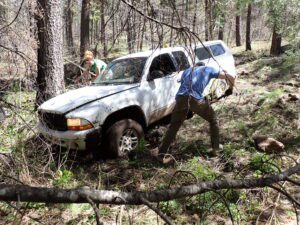
Our Monitoring Team heads out to the forests around New Mexico for several months each year to collect data on forest conditions, and then process that data to make it available for researchers and managers. To create robust data sets, our team must travel to some remote locations, often driving on difficult roads, and hiking with lots of equipment up and down mountainsides. In addition to a positive attitude and a strong back, this work requires a lot of training and planning, as well as flexibility and long workdays. To make this work possible, NMFWRI also has to maintain a small and reliable fleet of vehicles that regularly take a beating on remote roads, as well as a large inventory of tools and equipment that require regular cleaning, calibrating and maintenance. And the Monitoring Team has to prepare for week-long camping trips, with food, appropriate clothing, tools and safety equipment.
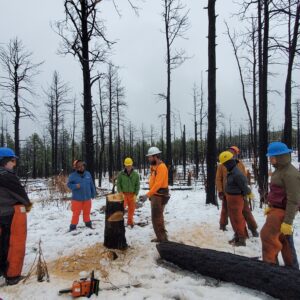
Our Outreach staff also spend a lot of time in the field, offering hands-on lessons to landowners and managers on practices to reduce the risk of damaging wildfires, post-fire flooding, and recovery and restoration on fire-impacted lands. These workshops and work days happen on private, public and tribal forest lands, and in communities near forests. Our Collaboration Team also spends time in the forests. While much of their work with collaborative groups occurs indoors, at coordination meetings, our team also works with collaboratives to arrange site visits to forested areas, where group members can observe shared needs and coordinate solutions. These field days are valuable from an educational perspective, but also for building partnerships that facilitate collaborative work. Our GIS staff also spend time in the woods, preparing virtual forest tours and ground truthing maps.
Visits to these sites require a lot of preparation. Our staff push forward with their work through challenges presented by variable weather, forest closures, and coordination with partners and land managers. Staff must maintain defensive driving certifications to operate our 4-wheel drive vehicles, and they are trained in established protocols for safe operations. In September, our ability to do this work improved as we acquired a UTV that our staff can use in the field, at locations with difficult access. Using this vehicle also requires additional training and new safety protocols. Our funding from the State of New Mexico allowed for this purchase, which will help us to work more efficiently. Ensuring we have the proper equipment to do our work also allows us to expand the range of partners we can work with.
All of our staff do their part to contribute to our overall goal of working closely with partners to reduce the risk of catastrophic wildfires and increase the use of forest treatments, including carefully planned controlled burns, on federal, state, tribal and private lands. Our successes protect homes, wildlife habitat, water sources, recreational sites, and wilderness values that together contribute to making our beautiful home state the Land of Enchantment.